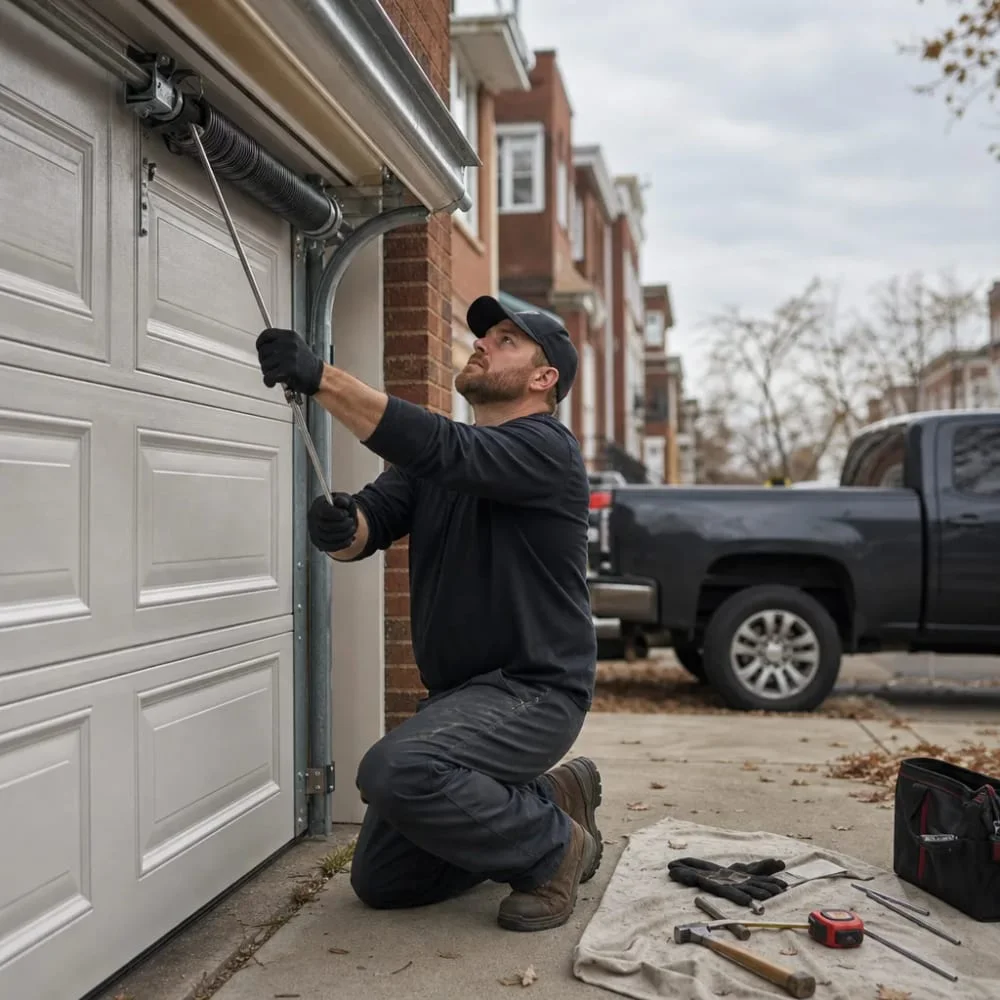
Diagnosing What's Wrong With Your Door
The part that looks broken often isn't the part that failed. A door that won't lift usually points to a spring, not the opener, and a door that keeps reversing often points to the safety sensors. Matching the symptom to the right part keeps you from paying for a repair that doesn't fix anything.
When your garage door acts up, most people blame the opener first. It's the part with the motor and the button, so it makes sense. But the opener doesn't lift your door. The springs do most of that work. The opener just guides the door up and down. If a spring or cable gives out, the opener gets blamed for a problem it didn't cause.
Here's a common case. You press the button. The motor hums or strains. The door rises a few inches, then stops or drops back down. It feels like a dead opener. In many cases, a torsion spring has snapped and the opener is trying to lift the full weight of the door alone. Its safety limits shut it down. If you replace the opener, the door still won't move. If you replace the spring, it often works again.
These are the symptoms that point to each part:
- A loud bang from the garage, then a door that won't open: very likely a broken spring. Look above the door for a spring with a gap in it.
- The door hangs crooked or one side sits lower than the other: often a cable that has slipped off its drum or frayed. Sometimes a spring on one side has failed.
- The door starts down, then reverses back up: often the safety sensors near the floor are out of line or dirty. It can also mean something is blocking the track.
- Grinding, scraping, or a jerky ride: often a bent track, worn rollers, or loose hinges and brackets.
- The motor runs but the door doesn't move: the opener may be disconnected from the door, or a gear inside the opener may be worn out.
- The wall button works but the remote doesn't: usually a dead remote battery or a remote that needs to be programmed again. This is rarely a repair job.
- Daylight, drafts, or water under the door: a worn bottom seal or weather stripping, not a mechanical failure.
Some problems stack. A spring that's getting weak makes the opener work harder every day. Over time, that can wear out the opener's gears. A bent track can pull a cable out of place. That's why we look at the whole system: springs, cables, tracks, rollers, hinges, the opener, and the sensors. Fixing only the part you noticed first can leave the real cause in place, and you'll be dealing with the same door again soon.
You can check a few things safely on your own. Look for a gap in the spring above the door. Wipe the sensor lenses and see whether the small lights on both sides are lit. Swap the battery in your remote. If one of those solves it, great. Springs and cables are a different story. They hold a lot of tension, and that tension is what makes them dangerous to handle without the right tools and training.
Once we've found the cause, you'll get written pricing before any work begins. You'll know what failed, what it takes to fix it, and what it costs, all before you agree to anything.
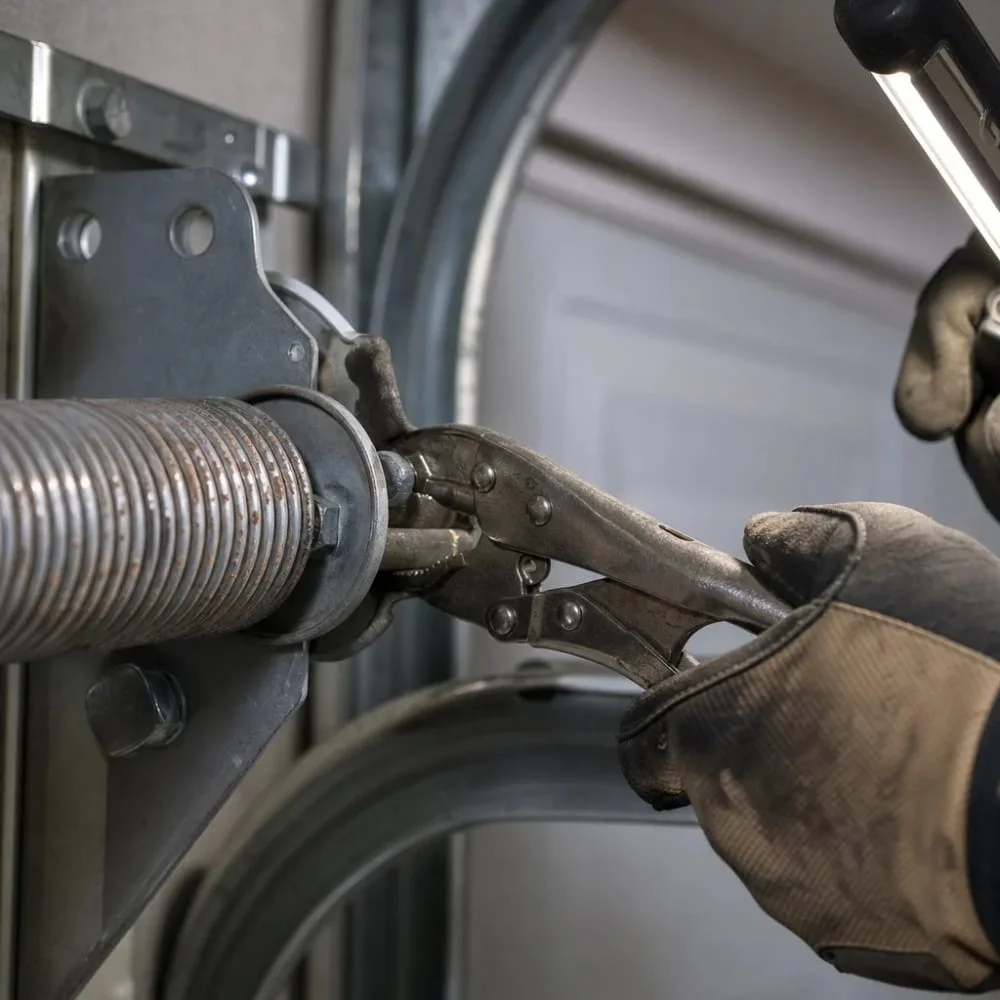
Why Spring and Opener Repairs Are a Safety Job, Not Just a Fix
Your garage door is the biggest moving thing in your house, and it's heavy. A standard two-car door can weigh as much as a couple of grown adults. The springs are what make it feel light. They're wound or stretched tight so they can carry almost all of that weight. That stored tension is what makes the door easy to lift, and it's also what makes spring work risky.
When a torsion spring is wound, it's holding a lot of energy. If a tool slips during winding or unwinding, that energy goes somewhere fast. It can spin a bar out of someone's hand or snap a cable loose. Older doors with extension springs along the side tracks have their own risk. A spring that breaks without a safety cable running through it can whip across the garage. These aren't rare freak accidents. They're the reason spring work takes the right tools, the right parts, and training.
A broken spring also changes how the door behaves. The door is now carrying its full weight with nothing holding it back. If it's stuck open, it's heavier than it looks. Keep people, pets, and cars out from under it until it's fixed.
Opener work is a safety job too, just in a different way. The opener isn't only there to move the door. It's also supposed to stop and reverse when something is in the way. That depends on the safety sensors near the floor and on the force settings inside the opener. Here's where people get into trouble. When springs get weak, the door feels heavy and the opener struggles. Turning up the force setting can make the door close again, but now the opener is pushing harder than it should. That can make the door less likely to back off if it meets a car bumper, a bike, or a child.
That's why we don't treat a spring or opener repair as a simple part swap. A safe repair means checking how the parts work together once the new part is in:
- The door is balanced, so it stays put when it's halfway open instead of drifting up or crashing down.
- The cables sit right on their drums and wind evenly on both sides.
- The springs match the door's weight and size, not just whatever fits the bracket.
- The opener's force and travel settings fit a door that's now properly balanced.
- The safety sensors line up and the door reverses when the beam is blocked.
Skip those checks and the door might go up and down fine today. But a door that's out of balance keeps wearing on the opener, the cables, and the hinges. And a door that doesn't reverse the way it should is a hazard every time someone pulls in or walks under it.
We're licensed and insured, and our service trucks are stocked, so we can usually handle the spring, cable, and opener work in one visit instead of leaving you with a half-fixed door. When we're done, the goal isn't just a door that moves. It's a door that's balanced, quiet, and safe to stand near.
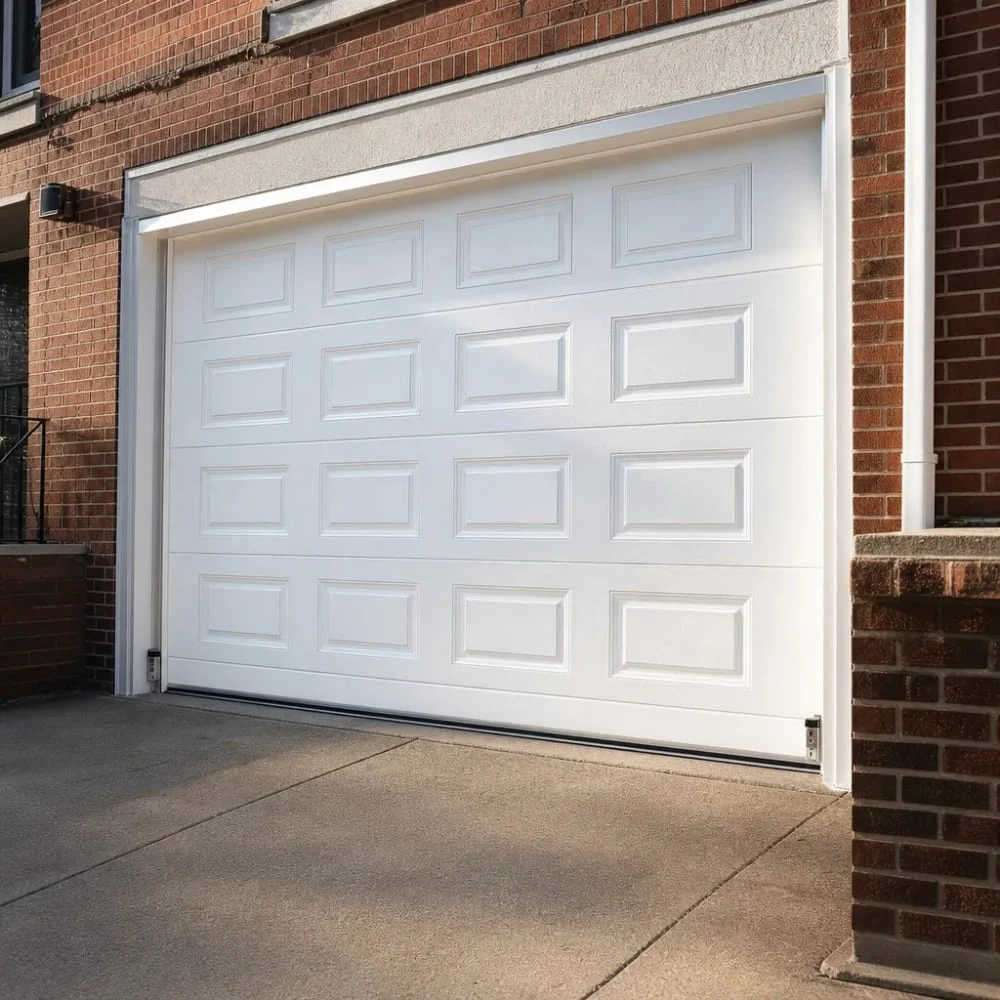
When You Don't Need a Repair Call
Not every garage door problem needs a technician. Some fixes take five minutes and cost you nothing. Other problems are real but can wait until it's convenient. Here's the honest list, so you don't pay for a visit you didn't need.
Before you call anyone, check these:
- Power to the opener. Make sure it's plugged in. Check your breaker panel, and look for a tripped GFCI outlet in the garage or a nearby bathroom. Plug a lamp into the same outlet to see if it has power.
- The manual lock. Many doors have a slide bolt or a handle lock on the inside. If it's locked, the opener will hum or strain against it, and the door won't budge. Unlock it and try again.
- The lock or vacation setting on the wall button. A lot of wall controls have a lock feature that blocks every remote while the wall button still works. Look for a lock button or a blinking light, and check your opener's manual.
- The emergency release. If someone pulled the red cord hanging from the opener rail, the door is no longer connected to the motor. The motor runs and the door sits still. Your opener's manual shows how to reconnect it.
- The quick checks we covered above. Swap the remote battery and wipe the sensor lenses before you assume anything is broken.
If one of those gets your door moving again, you're done. You didn't need us, and that's fine.
Some problems are real but aren't urgent. As long as the door opens, closes, and reverses the way it should, these can wait until it suits your schedule:
- A small dent in one panel that doesn't rub or catch as the door moves.
- A light squeak or rattle that hasn't changed or gotten louder.
- A thin strip of daylight at a bottom corner, or a cracked or torn bottom seal.
- Faded paint, scuffs, or other wear that's only about looks.
- A spare remote that won't pair. That's a programming job, not a repair.
None of those will get worse overnight. Keep an eye on them and get them handled when it's convenient. If a dent starts to scrape the track or a noise turns into a grind, that's when it moves up the list.
Here's where do-it-yourself stops. Stop using the door and don't try to adjust anything if you notice any of these:
- A spring with a gap in it.
- A cable that's frayed, loose, or hanging off its drum.
- A door that's crooked or has come out of its track.
- A door that feels very heavy when you lift it by hand.
- A door that won't stay put when it's halfway open.
Each of those involves parts under heavy tension, for the reasons explained above. Don't try to fix them by turning up the opener's force setting or loosening a bracket. Leave the door as is, keep people and cars clear, and have it looked at.
For everything else on this page, a little checking can save you a service call. We'd rather you try the simple stuff first and call us when the door really needs a repair.
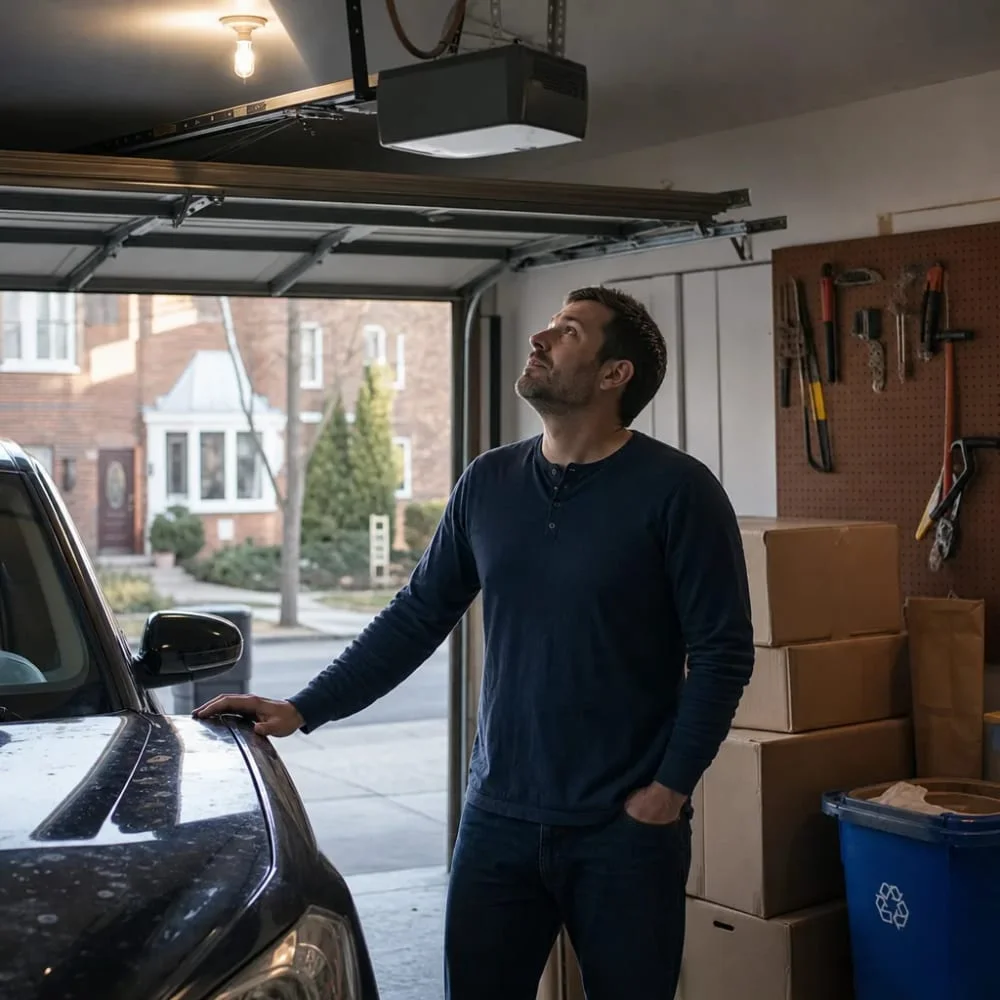
What Happens During a Repair Visit
Once you know your door needs a real repair, the next question is simple. What happens after you call? Here's what to expect, and what you can do to make the visit go smoothly.
You can call us at (484) 995-2611 or request a callback on our website. Our regular hours are 7AM to 9PM, seven days a week, and we also offer 24/7 emergency service. That covers problems that can't wait, like a door stuck wide open at night or a car trapped inside.
When you call, tell us what you saw and heard. A few details help us start in the right place:
- What the door is doing: won't open, hangs crooked, reverses, grinds, or won't close.
- Whether you heard a loud bang before it stopped working.
- Where the door is sitting now: open, closed, or stuck partway.
- The opener brand and rough age, if you know them.
- Whether it's a home garage door or a commercial roll-up door.
Before the visit, a little prep keeps things safe and quick:
- Leave the door as is. Don't force it up or down with the opener.
- Keep kids and pets out of the garage.
- Clear a few feet of space around the door, the side tracks, and under the opener.
- Have your remote handy and make sure the wall button is easy to reach.
At the door, we look at the whole system, not only the part you called about, for the reasons covered above. Then you get written pricing before any work begins. You can say yes, ask questions, or take time to think it over. Our trucks are stocked, so the common parts are often already with us.
It also helps to know how pricing works in this trade. Most garage door companies charge some mix of a service or trip fee, parts, and labor. Parts costs depend on your door. A heavy double door needs different springs than a light single door, and older or less common openers can take parts that are harder to find. After-hours and emergency calls often cost more than daytime visits. Whoever you hire, ask these questions before work starts:
- Is there a charge to come out and diagnose the problem?
- Will I get the price in writing before you start?
- Does the price include both parts and labor?
- What coverage comes with the repair, and where are the terms written down?
With us, parts and labor coverage comes with the repair, and the terms are written on your invoice. Keep that invoice somewhere you can find it.
Before the job wraps up, watch the door run a few full cycles. Ask to see the balance and reverse checks described in the safety section. A finished repair should look and sound right while you're standing there, not just after we've gone.
If your door won't open, hangs crooked, or won't close safely, call us at (484) 995-2611 or request a callback. We'll find the real cause and give you written pricing before any work begins.
What Drives Repair Cost Up or Down
The biggest thing that sets your repair cost isn't the symptom you noticed. It's how many parts the problem touched before someone found it. A door that stops working after a spring snaps can be a short job, or it can turn into springs, cables, and a bent track. The difference usually comes down to what happened in the hours or weeks around the failure.
These are the things that tend to push a repair bill up:
- Damage that spread. A broken spring by itself is one repair. If the door was run with the opener after the spring broke, a cable may have jumped its drum, a track may have bent, or the opener's gears may have stripped. Each of those adds parts and time.
- Forcing the door. Pulling a crooked door down by hand or pressing the button over and over can twist the tracks and crack the hinges. That's why we asked you to leave the door as is.
- Panels that are hard to match. One dented panel can sometimes be swapped out. If your door's style or color isn't made anymore, a single panel may not be possible. Then the choice is a patch that doesn't match or a bigger job.
- Springs sized wrong in the past. If an earlier repair used springs that don't fit your door's weight, the right fix means sizing the springs again from scratch, not just copying what's there.
- A commercial roll-up door. These are built differently from a home sectional door and use their own parts, so the repair isn't priced the same way.
These are the things that tend to keep a repair bill down:
- Catching it early. A spring that's getting weak, a roller that's starting to grind, or a cable with a few frayed strands costs less to handle before it fails and takes other parts with it.
- A clear description when you call. Telling us about the bang, the crooked door, or the grinding sound helps us bring the right parts the first time.
- Small fixes that are only small. Sensors that are out of line, a worn bottom seal, or a remote that needs to be paired again are quick jobs compared to spring or cable work.
- Fixing the cause, not just the symptom. Paying once to balance the door and set the opener right costs less than paying again in a few months for the same problem.
There's also the choice between repairing and replacing. An opener that's old and has worn gears can sometimes be fixed. But if parts are hard to find or the opener is near the end of its life, putting money into it may not make sense. The same goes for a door with damage across several panels. We'll tell you plainly which way we'd go and why, and the price for each option will be in writing so you can compare them side by side.
Add-ons like a battery backup or a keyless entry pad are separate from the repair. They're never needed to get your door working again, so you can say no to them and still have a complete repair.
Want to know what your repair will take before you commit to anything? Call us at (484) 995-2611 or request a callback. We'll check the whole door and give you written pricing before any work begins.
Garage door repair questions
- Can a garage door be repaired, or do I need a new one?
- Most garage doors can be repaired instead of replaced. Problems like broken springs, frayed cables, bent tracks, or misaligned sensors are usually fixable on their own. Replacement only makes more sense when damage has spread across several panels or an old opener's parts are hard to find. We'll give you written pricing for both options so you can compare before deciding.
- What is a fair price for garage door repair?
- Fair pricing depends on what failed, not just the symptom you noticed. A simple fix, like realigning sensors or pairing a remote, costs far less than spring, cable, or track work that involves heavy tension and specialized parts. Before hiring anyone, ask if there's a trip fee, whether the price is written down before work starts, and if parts and labor are both included. We give you that pricing in writing before any repair begins.
- Should I try to fix a garage door spring myself?
- No, you should never try to fix or adjust a broken spring yourself. Torsion springs hold enough stored tension to injure someone if a tool slips while winding or unwinding them, and older extension springs can whip loose without a safety cable in place. If you see a gap in the spring above your door, stop using the door, keep people and cars clear, and call for a repair instead of attempting it yourself.